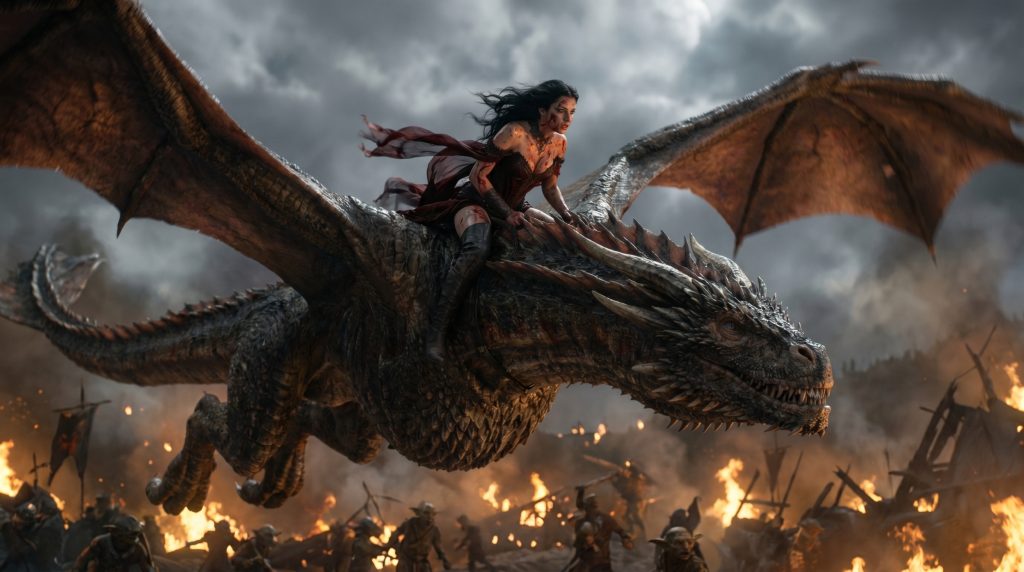
The smoke of Oakhaven did not rise to the heavens; it lingered, a thick, grey shroud that clung to the cobblestones like a funeral pall. For three days, the fires had gorged themselves on the cedar-wood districts and the libraries of the Old Guard. Now, as the embers cooled, a new silence settled over the city—not the silence of peace, but the held breath of the condemned.
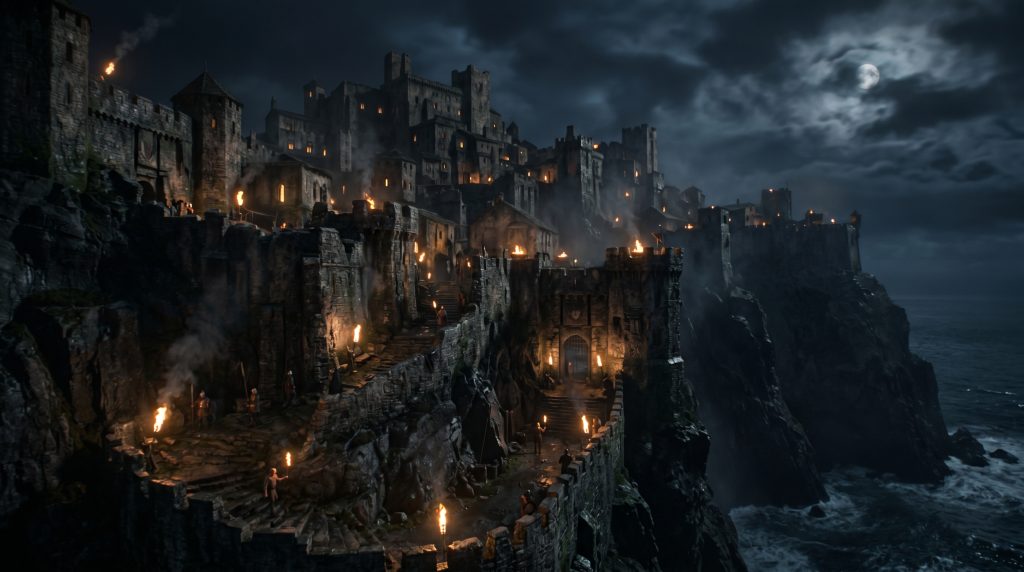
At the heart of the ruin stood the Spire of Solace. Its white marble was now marbled with soot, and the banners of the fallen King Valerius lay shredded in the gutters.
Elvira did not walk to the throne; she claimed it as if the stone had been waiting for her touch. She sat amidst the dust of the siege, her silver-white hair a stark contrast to the blood-dried leather of her armor. Her eyes, a piercing, predatory violet, swept over the kneeling remnants of the High Council.
“The city is quiet,” she said. Her voice was low, carrying the rhythmic chill of a sharpening blade.
“The resistance is broken, Your Majesty,” Lord Halloway stammered, his forehead pressed against the grime of the floor. “The people… they are afraid. They await for your mercy.”
Elvira leaned forward, the iron rings on her fingers clicking against the armrest. “Mercy is a luxury for the obedient. I have inherited a city of rot. One does not show mercy to gangrene; one cuts it out.”

The First Decree
The transition from liberator to tyrant happened in the span of a single heartbeat. By sunset of her first week, the “Cleansing of Oakhaven” had begun.
It started with the Tax of the Fallen. Elvira decreed that every household must pay a tribute in silver for every family member killed in the siege—a literal price on grief. When the treasuries were full, she turned her gaze toward the “idlers.” Artists, scholars, and the elderly were rounded up, deemed “drains on the new sovereignty.”
The city markets, once vibrant with the scent of cinnamon and the roar of trade, became ghost towns. The only sound now was the rhythmic clack-clack of the Iron Guard’s polearms against the stone.
“Order is not born from love,” Elvira whispered to her reflection as she donned the crown of blackened gold. “Order is the shape a shadow takes when the light is extinguished.”
The Weight of Iron
Under Elvira’s reign, the sun seemed to lose its warmth. She ordered the Great Windows of the Spire to be boarded up with lead-lined oak. She preferred the dim flicker of tallow candles; it hid the mounting corpses in the courtyards.
By the second month, the “Whisperers” appeared—her secret police. To speak the name of the old King was a death sentence. To weep in public was “civil sedition.” The despair was no longer a feeling; it was the city’s new architecture.
One evening, a young girl was brought before the throne for stealing a loaf of bread from the royal kitchens. The girl couldn’t have been more than ten, her face smeared with the soot that now defined Oakhaven.
“Why did you take it?” Elvira asked, her expression unreadable.
“I was hungry, Milady,” the girl whimpered. “My father… he hasn’t come home from the mines.”
Elvira stood, her heavy velvet robes trailing behind her like a spill of wine. She reached out, tilting the girl’s chin up with a cold, pale hand. For a second, the court held its breath, hoping for a flicker of the humanity Elvira had once claimed to possess.
“Hunger is a sign of a weak spirit,” Elvira said, her voice devoid of heat. “And thieves are a stain on my city.”
She turned to the Captain of the Guard. “Take her to the Gate. Let the city see what happens to those who cannot master their own bellies.”
As the girl’s screams faded down the vaulted hallway, Elvira returned to her seat. She didn’t look at the council. She didn’t look at the blood on the floor. She simply picked up a quill and signed the next execution order, her hand steady, her heart a tomb.
The Queen was settled. The city was dying. And in the darkness of the Spire, Elvira finally felt at home.
Beyond the soot-choked walls of Oakhaven, where the lush farmlands had long since turned to dust under Elvira’s heavy taxes, lay the Obsidian Expanse. It was a place of jagged rock and permanent twilight, a land that even the bravest scouts of the old kings had feared to tread.
But while Elvira was busy strangling the life out of her subjects, something was breathing life into the wastes.
The Scavenger of Empires
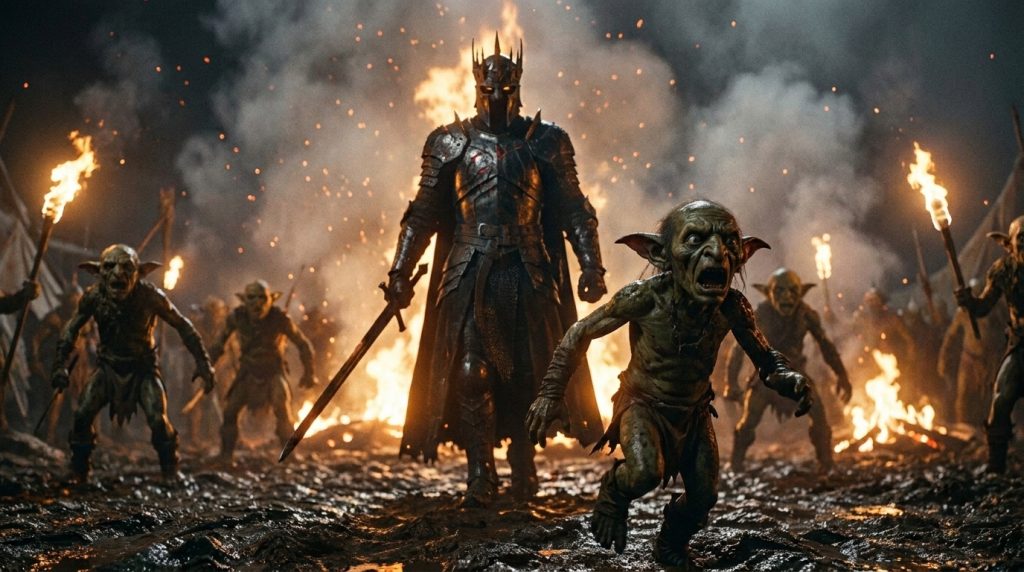
At the head of a column that stretched for miles rode Thrakos the Maw. Thrakos himself was a mountain of scarred flesh and black plate armor, a warlord who had spent decades waiting for a city as rich as Oakhaven to bleed itself dry.
He did not carry a banner of cloth. Instead, a pike behind his saddle bore the bleached skulls of a dozen rival chieftains. He didn’t need to speak to command; the rhythmic, guttural chanting of ten thousand orcs provided a constant, terrifying heartbeat to their march.
“The wind smells of copper and wood-ash,” Thrakos rumbled, his voice like grinding stones. He inhaled deeply, tasting the despair drifting from the city. “The Queen has done the hard work for us. She has broken their spirits. Now, we only have to break their bones.”
The Horde Awakens
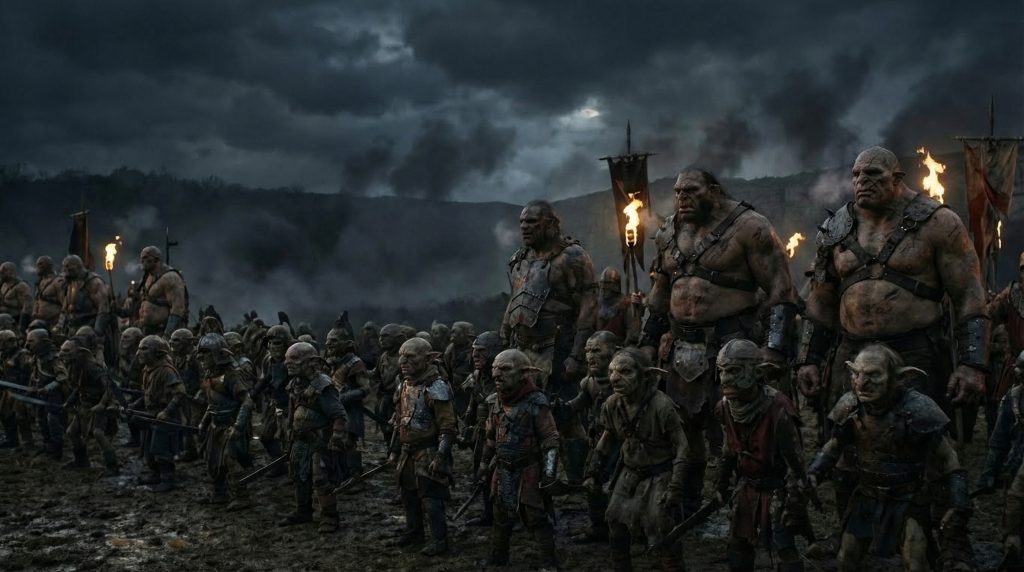
The army was a chaotic, terrifying tapestry of malice:
The Goblin Skirmishers: Chattering like a fever dream, thousands of green-skinned whelps scurried in the shadows of the larger orcs, carrying jagged shivs and pots of volatile “fire-oil.”
The Iron-Hide Orcs: The core of the legion. Their armor was scavenged from a hundred fallen battlefields, mismatched but impenetrable.
The Siege-Beasts: Massive, lumbering trolls dragged catapults made from the ribcages of dead leviathans, their eyes blinded by leather hoods to keep them focused only on the scent of the meat ahead.
They didn’t march with the discipline of Elvira’s Iron Guard; they moved like a flood of sludge, slow and inevitable, consuming everything in their path. The few outlying villages that Elvira hadn’t already pillaged were wiped from the map in a single night of fire and screaming.
The Silent Alarm
Inside the Spire of Solace, the air was cold. Elvira sat at her map table, pushing small lead markers across the parchment. She was calculating how many more “traitors” she could conscript into the sulfur mines before the workforce collapsed.
The door to her solar creaked open. Her Captain of the Guard, a man whose soul had withered as fast as the city, knelt before her. He was trembling.
“Your Majesty,” he whispered, his eyes fixed on her boots. “The watchtowers at the Northern Rim… they’ve gone dark.”
Elvira didn’t look up. “Then send a detachment to hang the sentries for sleeping on watch.”
“It isn’t sleep, Milady,” the Captain said, his voice cracking. “The signal fires weren’t lit… because the towers are gone. There is a shadow moving across the plains. A shadow that moans and smells of the pit.”
Elvira finally lifted her gaze. For the first time since she had taken the crown, a flicker of something other than contempt crossed her violet eyes. It wasn’t fear—not yet—but a cold realization.
She had spent so much time sharpening the blade against her own people that she had forgotten to check the horizon.
“Let them come,” she said, her voice dropping to a dangerous silkiness. She stood, the blackened gold of her crown catching the dim candlelight. “This city is mine. I have burned it, bled it, and remade it in my image. I will not yield it to a pack of mongrels.”
Outside, a low horn sounded in the distance—a deep, mournful blast that shook the very foundations of the Spire. The wolves were at the door, and the Queen of Despair was about to find out if a city of broken people would fight for their tormentor.
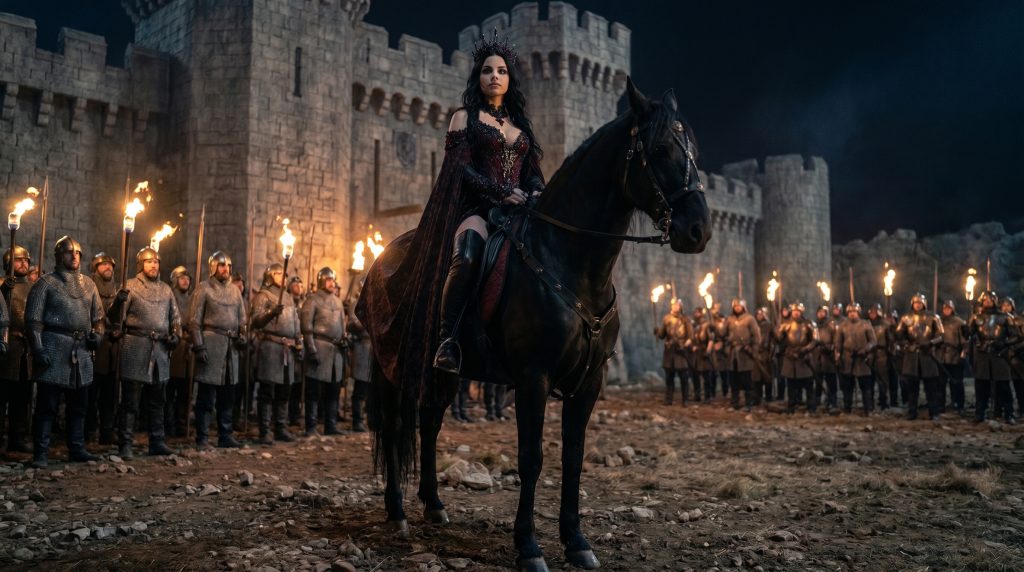
The gates of the Spire of Solace groaned open, a sound like a giant’s teeth grinding in the dark. Elvira emerged, not as a defender, but as a Goddess of spite. She sat astride Nocturn, a stallion as black as a starless night, its eyes clouded with the same violet sorcery that burned in her own.
Her armor was a masterpiece of obsidian and etched silver, molded to her frame like a second, lethal skin. A cloak of raven feathers trailed behind her, catching the soot-laden wind. She did not wear a helmet; she wanted the world to see her face—the pale, cold perfection of a woman who had forgotten how to bleed.
The Death of Sound
As she rode through the main thoroughfare, the city did not erupt in cheers. There were no flowers thrown, no prayers whispered for her victory. Instead, Oakhaven suffered a collective stroke of terror.
The rhythmic clatter-thud of Nocturn’s hooves provided the only heartbeat for the silent street, a solitary sound that sent a wave of paralysis through the skeletal remains of the city. High above, the wooden blinds of the tenements slammed shut with frantic desperation, the residents knowing all too well that to meet the Queen’s eyes was to invite a gaze that functioned as a final death warrant. Beneath the eaves, heavy oak doors were bolted and barred in a frantic sequence of iron striking stone, leaving families to huddle in the stifling dark where they drew shallow, terrified breaths. At the edge of a narrow alleyway, a mother caught a flash of that lethal silver-white hair and let out a choked, instinctive sob; she did not merely lead her son away but wrenched him violently from the cobbles, hurling him into the lightless shadows of a cellar and covering his mouth with a hand that shook with the terrible palsy of the damned.
Elvira didn’t blink. A thin, arrogant smile touched her lips as she noted the vacuum of life her presence created. She found the silence more honest than any anthem. To her, their fear was the only true form of loyalty.
“Look at them,” she murmured to her Captain, her voice carrying easily in the dead air. “They are so afraid I might lose that they’ve forgotten to be afraid I might win.”
The Threshold of Ruin
The Great Gate of Oakhaven—once a symbol of the city’s golden age—now stood shattered, its iron bars twisted like dry grass. Beyond it lay the killing fields, and there, the horizon had been replaced by a wall of filth and iron.
Elvira halted her horse at the edge of the ruins. Behind her stood three hundred Gloom-Knights, their plate armor magically darkened, their faces hidden behind visors shaped like snarling wolves. They were few, but they were elite, bound to her by blood-oaths and dark enchantments.
Five hundred paces across the mud and bone-strewn plain, the Horde waited.
Thrakos the Maw moved to the front of his line. His dire-boar snorted, splashing black bile into the muck. The Warlord was a titan of ugliness; his lower jaw had been replaced by a jagged plate of rusted steel bolted directly into his skull—hence the name. He raised a massive, notched cleaver that still dripped with the remnants of the morning’s scouts.
“So,” Thrakos roared, his voice a guttural explosion that made the air vibrate. “The little bird comes out of her cage! I expected a King, not a doll dressed in funeral silks!”
The orcs behind him erupted in a cacophony of shields clashing and high-pitched, manic goblin laughter. The stench of the army—wet fur, rot, and cheap iron—hit the Queen’s line like a physical blow.
Two Evils Entwined
The contrast was a portrait of the world’s end.
On one side was Elvira: the refined, elegant cruelty of a high-born shadow. She was the cold frost that kills the harvest—beautiful to look upon, but fatal to touch. Her knights were silent, disciplined, and utterly hollow.
On the other side was Thrakos: the raw, screaming hunger of the pit. He was the fire that consumes the forest—loud, messy, and driven by a singular, primal need to tear and rend.
Elvira raised a single, gloved hand. A faint violet aura began to ripple around her fingers, the air beginning to hum with the static of a brewing storm. She looked at the thousands of monsters before her—the tide of green flesh and yellow teeth—and her eyes didn’t waver.
“You speak of cages, beast,” Elvira said, her voice magically amplified so it cut through the orcish din like a razor. “But you fail to see the bars. This city is not my refuge. It is your tomb.”
She lowered her hand, pointing her index finger directly at Thrakos’s heart.
“Advance.”
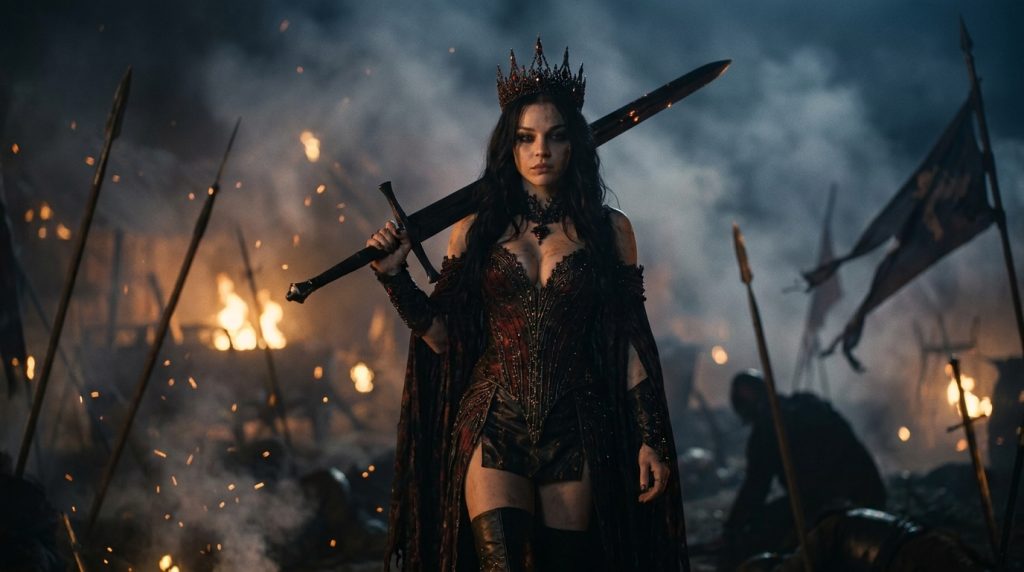
The air exploded in a cacaphony of wet thuds and high-pitched screams as the two tides of malice collided. It was not a battle of tactics but a slaughter of sheer will, where the Gloom-Knights’ disciplined steel sheared through green flesh, only to be buried under the weight of a thousand snarling bodies. The mud of the plain quickly vanished, replaced by a steaming red mire that sucked at boots and hooves alike. Elvira moved through the carnage like a specter of death, her twin-bladed staff—a lethal pole of silver-etched obsidian—spinning in a blur that left a trail of severed limbs and geysers of dark ichor in its wake. She was a dancer in a butcher shop, her violet eyes glowing with a terrifying, ecstatic pride as she carved a path toward the center of the storm.
There, amidst a pile of broken bodies, stood Thrakos the Maw. Elvira halted, her breathing steady despite the chaos, and flicked the gore from her blades with a contemptuous snap of her wrists. “You smell of the trough, Warlord,” she spat, her voice ringing clear over the guttural roars of the dying. “Kneel, and I might grant you the mercy of a quick decapitation. Stand, and I will peel the soul from your wretched meat.”
Thrakos answered with a sound that was half-laugh, half-growl, and swung his massive cleaver in a horizontal arc that whistled through the air. Elvira slipped beneath the blow with feline grace, her twin blades flickering like a snake’s tongue. She was faster, a blur of obsidian and moonlight that left deep, jagged gashes across Thrakos’s barrel-like chest. Each time the Warlord swung, she was already gone, reappearing to deliver another stinging strike. Her arrogance swelled with every drop of black blood she drew; she began to toy with him, spinning her weapon in showy displays of martial prowess, convinced that brute force could never touch her divine perfection.
But Thrakos was a creature of a thousand scars, and he knew the weight of a dying moment. As Elvira lunged for a final, theatrical strike at his throat, the Warlord did not flinch. He leaned into the blade, allowing the silver steel to bury itself deep in his shoulder, and used the moment of contact to seize the center of her weapon with a gauntleted hand. The sound of straining metal and snapping bone echoed across the field. Before Elvira could react to the loss of her momentum, Thrakos’s massive fist collided with her face, a blow that carried the force of a falling siege engine.
She hit the mud with a sickening crunch. The world spun into a blur of grey sky and red earth. Thrakos loomed over her, a mountain of shadow, and reached down with a meaty claw. He didn’t take her life; he took her pride. With a violent jerk, he ripped the blackened gold crown from her brow, tearing silver-white strands of hair with it. He held the prize aloft, letting out a roar that shattered the last remnants of the knights’ resolve.
The Gloom-Knights, seeing their goddess fallen and uncrowned, buckled under the renewed frenzy of the orcs. Chaos turned into a rout. The Captain of the Guard, his armor shattered and his face a mask of blood, spurred his horse through the melee, trampling goblins to reach his broken Queen. He didn’t ask for permission; he hauled Elvira’s limp, half-conscious form across his saddle and turned Nocturn back toward the city. The retreat was a frantic, bloody scramble as the remnants of the knights fled like beaten dogs. They barely cleared the threshold of the Great Gate before the heavy iron portcullis slammed down, leaving the screams of those left outside to be silenced by the Maw’s hungry horde. Inside the keep, the silence of the city had returned, but it was no longer the silence of fear—it was the silence of the doomed.
The healing chambers of the Spire smelled of vinegar, burnt lavender, and the metallic tang of Elvira’s own blood. Her knights moved with a funereal quiet, their armor clinking softly as they applied poultices to the jagged gash where her crown had been violently uprooted. Her face was a mosaic of violet bruising, one eye swollen shut from Thrakos’s iron fist, yet her remaining eye burned with a cold, frantic light. Outside, the walls of Oakhaven groaned under the rhythmic assault of the Horde’s siege engines. Every few minutes, a massive stone from a troll-pulled catapult would strike the ramparts, sending a vibration through the floorboards that felt like the city’s final, stuttering heartbeat. Elvira knew the stone would not hold forever; Thrakos was not merely attacking a fortress, he was chewing through it.
“Bring me my cloak,” she rasped, her voice sounding like dry parchment rubbing together. As her knights hesitated, Elvira’s gaze drifted toward the floor—not at the stone, but at the miles of darkness beneath it where the Great Black Dragon, Vyrathax, lay in a slumber of smoke and spite. The decision crystallized in her mind with a terrifying coldness; she would not send her men to the walls to die for a lost cause, nor would she wait for Thrakos to claim her head. She would descend into the abyss and rouse the ancient terror that had been the foundation of her power and her greatest curse. It was a suicidal gamble, a choice between a quick death by an orc’s blade or a slow, agonizing conflagration in dragon-fire.
The Grand Meister Valerius stepped forward, his face a mask of frantic horror. He clutched at her sleeve, his voice cracking as he reminded her that Vyrathax had not been fed or spoken to in years. To the dragon, Elvira was not a queen; she was a wounded, bleeding scrap of meat that smelled of weakness and failure. He warned her that no spell could bind a creature of that age once its hunger was piqued, and that she possessed neither the strength nor the sorcery to command its will. He pleaded with her, insisting that the dragon would likely snap her spine before she could even utter a command, turning the keep into her own funeral pyre. If she woke the beast while she was this broken, she wouldn’t be a rider; she would be a sparse meal of bone and flesh.
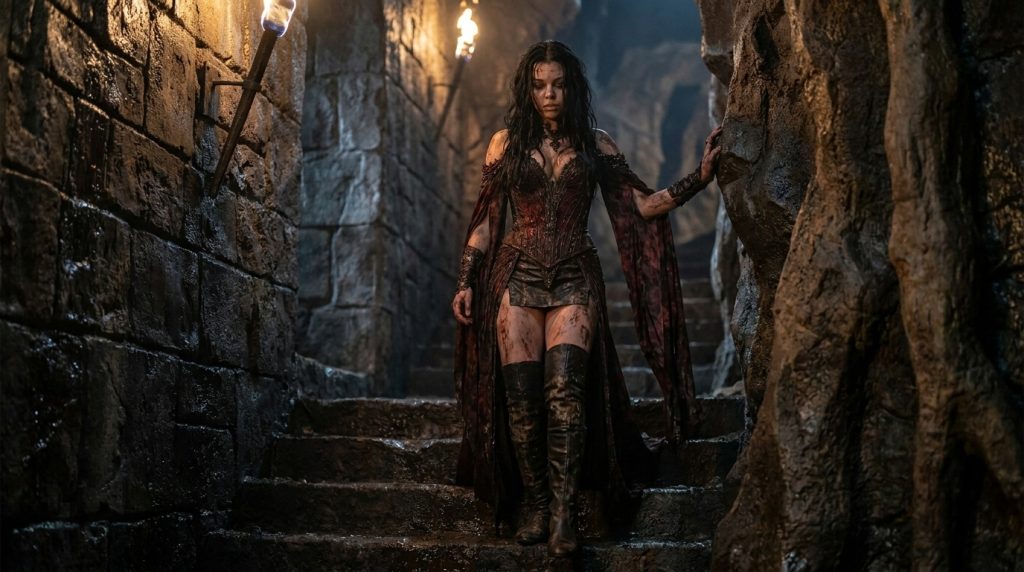
Elvira shook him off with a snarl, the effort sending a fresh bloom of blood through her bandages. Her arrogance was the only thing holding her shattered ribs together. She didn’t care if the dragon devoured her, so long as it burned Thrakos first. She seized a torch, the flame dancing wildly in the drafty hall, and turned toward the hidden spiral staircase that led to the roots of the mountain. Every step downward was a battle against her own collapsing body. The heat began to rise, thick and oppressive, carrying the scent of sulfur and old, baked earth. Her breath came in wet gasps as she bypassed the screaming prisoners in the high dungeons, descending further into the silence where the air grew so hot it blistered the back of her throat.
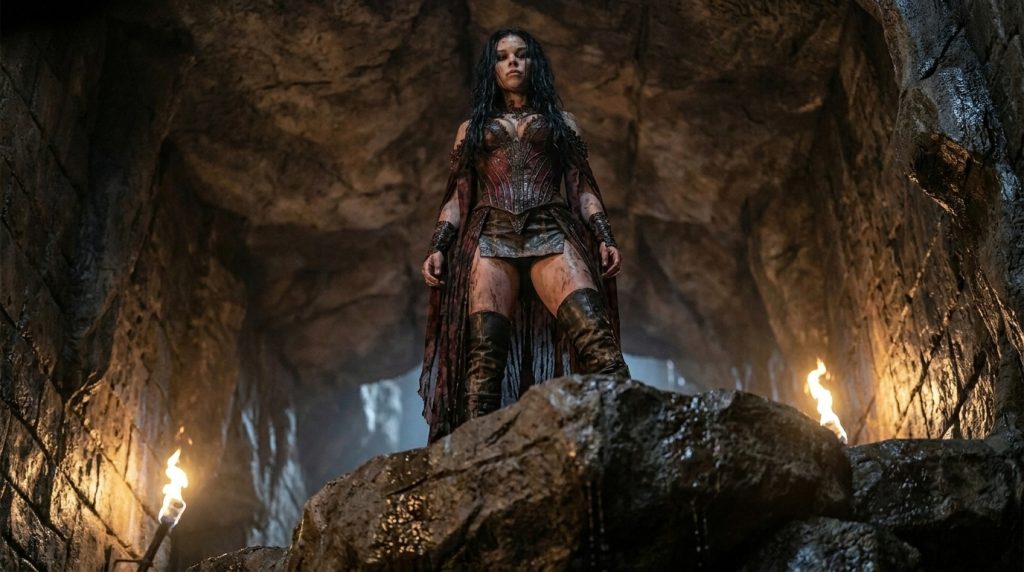
By the time she reached the bottom, her vision was swimming in a red haze of pain and exhaustion. Before her stood the colossal double doors of star-iron, etched with the warning of a thousand dead priests: “The Sun Ends Here.” The runes of binding were dim, flickering like dying embers, and the very iron seemed to pulse with the rhythmic, heavy thud of a heart the size of a siege engine. Elvira reached out, her fingers trembling as they touched the searing metal. She knew that once she crossed this threshold, there was no guarantee of return, no promise of loyalty, and every likelihood that her final sensation would be the closing of a maw that had swallowed kingdoms. With a shove that cost her the last of her strength, the doors groaned open, revealing a cavern filled with a low, golden glow—and the sound of a massive, leathery wing shifting in the dark.
The air inside the den was not merely hot; it was heavy, a physical weight that pressed against Elvira’s shattered ribs like a phantom hand. As she stepped deeper into the gloom, her torchlight died, smothered by the sheer density of the dragon’s aura. In its place, a rhythmic, volcanic glow pulsed from the center of the cavern. Vyrathax was a mountain of scorched metal made flesh. His scales were jagged plates of obsidian, layered one over the other like the shingles of a cursed cathedral, each one etched with the scars of a thousand forgotten wars. His folded wings were vast, leathery sails that draped over mounds of tarnished gold and the bleached bones of long-dead challengers, while his tail coiled around the base of a massive stone pillar like a sleeping viper.
Elvira stood before the creature’s snout, a space large enough to swallow a horse whole. Wisps of acrid, violet smoke curled from his nostrils, each exhale rattling the loose coins on the floor with a sound like shifting gravel. She felt small—a wounded, porcelain doll in the path of a landslide—but she refused to let her knees buckle. She drew a ragged breath, the heat blistering her throat, and raised her trembling, blood-stained hands into the shimmering haze.
“Vyrathax!” she commanded, her voice cracking but carrying the iron-wrought authority of her ancestors. “The blood of the Spire calls you. The fires of the sun have dimmed, and the earth reeks of the mongrel’s scent. Wake, and reclaim your sky!”
The Rising Cinder
The silence that followed was absolute, a void of sound that stretched until Elvira could hear the frantic drumming of her own pulse. Then, the mountain moved. A low, tectonic rumble vibrated through the floorboards of the entire city above as Vyrathax uncoiled. The golden eye cracked open, a vertical slit of pure, molten malice that fixed upon the tiny, broken woman before him. He did not roar; he inhaled. The air rushed into his lungs with the force of a gale, sucking the heat from the room and leaving Elvira shivering in the sudden draft.
The dragon lunged forward, his neck snapping out with a speed that defied his massive bulk. His snout stopped inches from Elvira’s chest, the heat from his nostrils searing the fabric of her cloak. He let out a low, vibrating hum—a sound so deep it resonated in Elvira’s marrow, threatening to shake her internal organs apart. He was tasting her fear, weighing the scent of her Royal blood against the pungent aroma of her failure and the copper tang of her wounds. His upper lip curled back, revealing rows of teeth like blackened daggers, each one stained with the soot of a century’s slumber.
In that heartbeat, the world balanced on a razor’s edge: the Great Death-Bringer was deciding whether to become a weapon or a crematorium.
Elvira did not flinch. Her vision blurred with pain, her one good eye fixed on the golden sun of the dragon’s iris. With a final, desperate surge of arrogance, she reached out. Her fingers, slick with the gore of the battlefield, brushed against the sensitive, heat-pulsing skin of his muzzle. It was an act of supreme madness, a challenge to a god.
The humming stopped. Vyrathax’s golden eye narrowed, the vertical pupil dilating until it nearly swallowed the iris. For a terrifying eternity, the beast stared into the soul of the woman who dared to touch him. Then, with a slow, heavy sigh that smelled of ancient soot and scorched earth, the Great Cinder lowered his head. He pressed his snout firmly into her palm, a gesture of profound, terrifying submission. The dragon had found his rider, and the Queen had found her vengeance. Outside, the walls of Oakhaven continued to crumble, but inside the dark, a new sun was beginning to rise.
The sky over Oakhaven was no longer a canopy of stars; it was a rain of fire and screaming stone. The great catapults of the Horde groaned with rhythmic cruelty, launching boulders wrapped in pitch that shattered against the city’s spires, turning once-proud libraries and homes into pyres of cedar and bone. In the gutters, the citizens huddled in the reek of their own terror, clutching icons of forgotten gods and whispering curses against the Queen who had retreated into her stone womb while the world burned. To them, Elvira was a ghost, a coward who had traded her subjects’ lives for a few more hours of hollow sanctuary. Despair had become the only law left in Oakhaven, a thick, suffocating smoke that heralded the coming of the end.
But then, the air changed. A sudden, unnatural chill swept over the battlements, as if the very atmosphere had been sucked away by a titan’s breath. High above, against the cold, indifferent silver of the full moon, a silhouette emerged—a blot of absolute darkness that seemed to swallow the light. On the crumbling walls, a dying sentry pointed a trembling finger upward, his voice a choked rattle. The shape grew, unfurling wings that spanned the width of a district, trailing wisps of violet smoke that shimmered like a bruised aurora. The realization hit the city and the siege-camp simultaneously, a shockwave of primal recognition that froze the blood. Elvira had not fled; she had reached into the ancient, forbidden earth and dragged its most terrible secret into the sky. Vyrathax had returned.
The Orcish war-cries, which had been a cacophony of bloodlust and victory, died in a thousand throats. The excitement of the slaughter was instantly replaced by a fear so ancient it was written in their marrow. They looked up and saw not a beast, but an apocalypse. Vyrathax tilted his wings, banking with a grace that mocked the laws of physics, and dove.
The first pass was a scouring of the soul. The dragon did not merely breathe fire; he exhaled a torrent of violet-white plasma that turned the mud of the plain into bubbling glass. The front lines of the Iron-Hide Orcs didn’t even have time to scream. Their armor, scavenged from a hundred wars, became their sarcophagi, melting in a heartbeat and fusing with their liquefying flesh into a hissing, incandescent slag. Goblins were vaporized where they stood, leaving behind nothing but scorched shadows etched onto the blackened earth. The air was filled with the sickening, sweet smell of rendered fat and the hiss of boiling blood as the fountain of fire swept through the siege-engines, turning the massive wooden structures into matchwood and ash.
Vyrathax banked for a second pass, his roar a tectonic shriek that burst the eardrums of those few who survived the initial blast. This time, he flew lower, the heat from his belly igniting the very oxygen around the fleeing Horde. Orcs ran like living torches, their skin peeling away in charred ribbons as they clawed at eyes that had been cooked in their sockets. It was a harvest of meat and iron. The chaos was absolute; the disciplined army of Thrakos had become a panicked mass of prey, trampling one another into the burning mire in a futile attempt to escape a predator that owned the very sky.
When the sun began to peek through the haze of the morning, the field outside Oakhaven was a silent, steaming wasteland of grey ash and fused metal. Ten thousand invaders had been reduced to a layer of soot that coated the cobblestones. Yet, as Elvira circled the ruins of her victory, her violet eyes searched the carnage in vain. There were no remains of the great dire-boar, no scorched skull with a steel jaw, and no sign of the blackened gold crown. Thrakos the Maw had vanished into the smoke of his own destruction, and with him, the symbol of her sovereignty had been carried away into the dark.